
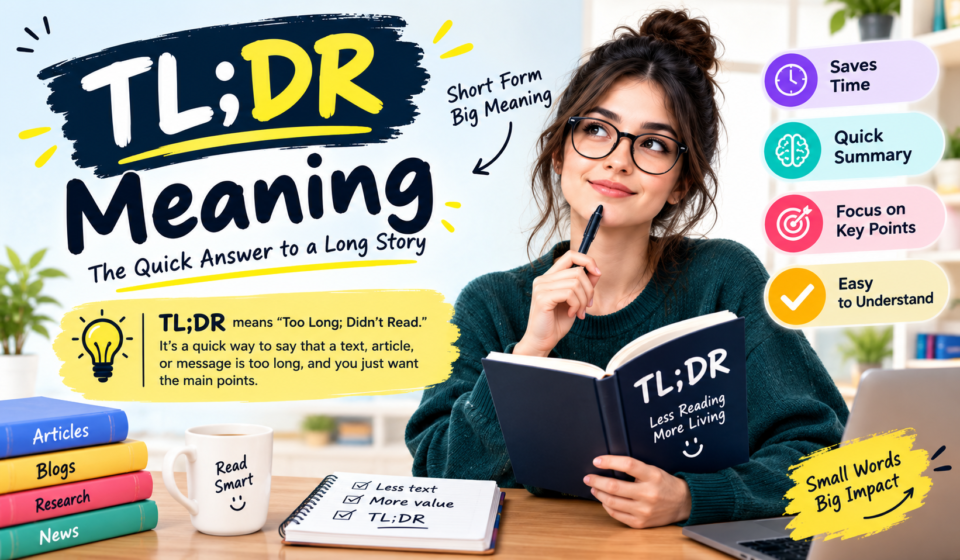

The internet has created thousands of short words, abbreviations, and expressions that make online communication faster. One of the most common examples is tl dr meaning. You may have seen it at the beginning or end of an article, social media post, email, forum discussion, or online conversation.
But what does TL DR mean, and why do people use it so often?
TL DR stands for “Too Long; Didn’t Read.” It is commonly used to introduce a short summary of a longer piece of content. Instead of reading several paragraphs, someone can look at the TL DR section and quickly understand the main point.
In today’s fast-moving digital world, TL DR has become a practical way to make information easier to scan and understand.
What Does TL DR Mean?
TL DR is an abbreviation for “Too Long; Didn’t Read.” The phrase originally described a person who did not read a long message because it contained too much information.
Over time, its meaning changed slightly. Today, TL DR is often used in a helpful way rather than as criticism. Writers use it to provide a quick summary for readers who want the most important information without going through the entire article.
For example, imagine an article contains 2,000 words explaining a complicated topic. A writer may add a TL DR section near the beginning that explains the main idea in two or three sentences.
This allows readers to choose between reading the complete article or getting the main information quickly.
What Does TL DR Stand For?
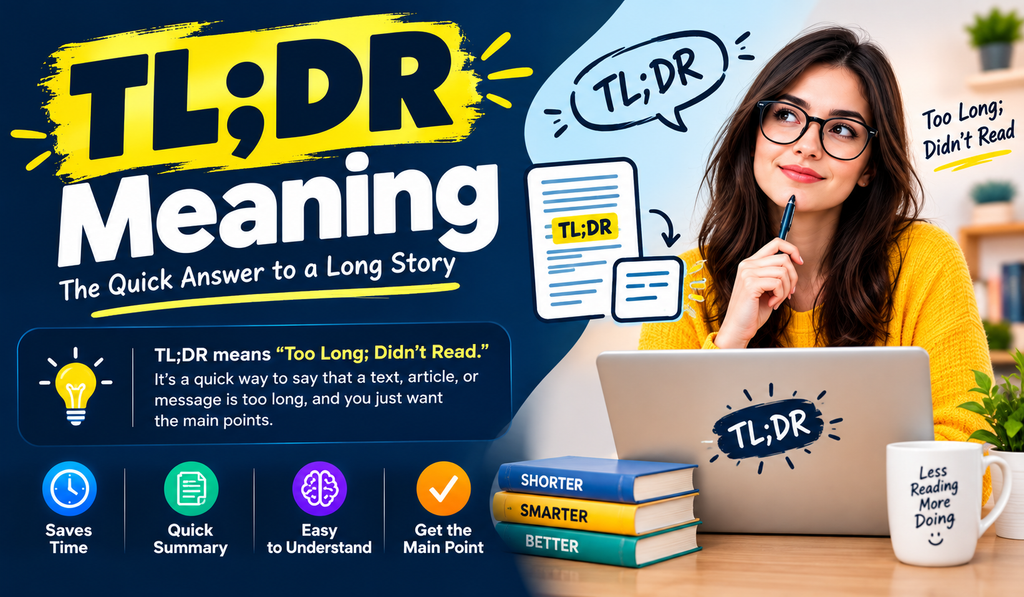
TL DR stands for Too Long; Didn’t Read.
Each letter represents part of the phrase:
- T = Too
- L = Long
- D = Didn’t
- R = Read
Although the abbreviation originally had a negative or humorous meaning, modern internet users frequently use it simply to mean “short summary.”
You may also see it written as TLDR, TL;DR, or TL DR. All three forms generally refer to the same expression.
Why Is TL DR So Popular Online?
People receive more information today than ever before. Social media feeds, emails, websites, news articles, online discussions, and business messages can contain a huge amount of text.
Most readers do not have enough time to read everything in detail.
This is one reason TL DR became popular. It gives readers a quick way to identify the main point of a long message.
For website owners and content creators, a useful TL DR section can also improve the reading experience. Visitors can quickly understand what the page is about and then decide whether they want to explore the complete content.
What Does TL DR Mean in Texting?
In texting, TL DR usually means that a message or explanation is too long to read completely.
For example, someone might send a friend a very long explanation about a situation. The friend could reply:
“TL DR?”
In this context, they are asking for a short version of the story.
Another person might write:
“TL DR: We changed the meeting to Friday.”
Here, TL DR introduces the most important information.
The meaning depends on the conversation and the relationship between the people. Among friends, it can be casual and humorous. In professional communication, it can also be useful when presenting a quick summary.
What Does TL DR Mean on Social Media?
On social media, TL DR is often used before a short summary of a longer post.
For example, a person might write a detailed LinkedIn post about a business project and finish with:
TL DR: The project increased customer engagement and reduced costs.
This helps people who are quickly scrolling through their feed.
Because social media users often consume content rapidly, short summaries can make longer posts easier to understand.
How Do You Use TL DR in a Sentence?
Using TL DR is simple. It is normally placed before a short summary.
For example:
“TL DR: The new update improves performance and adds several useful features.”
It can also appear at the end of a long explanation:
“TL DR: The main reason for the delay was a technical problem.”
In casual conversations, someone might simply ask:
“TL DR?”
This means they want the main point without reading or hearing the complete explanation.
Is TL DR Rude?
TL DR is not automatically rude. Its meaning depends on how it is used.
If someone responds to another person’s long message with “TL DR,” it may sound dismissive because they are saying they did not read the entire message.
However, when a writer adds a TL DR section to their own content, it is usually considered helpful.
For example, a professional article might begin with a short summary followed by detailed information. This gives readers more control over how they consume the content.
The safest approach is to consider the audience and situation before using the abbreviation.
What Is the Difference Between TL DR and a Summary?
TL DR and a summary have very similar purposes, but they are not exactly the same.
A summary is a shortened version of longer content that explains its important points.
A TL DR is also a short version, but the term is more informal and strongly associated with internet culture and online communication.
For example, a business report may contain a section called “Executive Summary.” A casual blog post might use “TL DR” instead.
The information can be similar, but the tone is different.
Where Can You See TL DR Used?
TL DR can appear in many different types of online content.
You may see it in:
- Blog articles
- Reddit discussions
- Social media posts
- Online forums
- Emails
- Text messages
- News discussions
- Product explanations
- Technical documentation
- Business communications
It is especially common when a topic requires a long explanation but readers may only want the main conclusion.
Why Should Writers Add a TL DR Section?
Adding a TL DR section can make long content more accessible.
Some readers want detailed information and are happy to read an entire article. Others want an immediate answer.
A TL DR section can serve both groups.
A good TL DR should be short, accurate, and useful. It should not introduce information that is completely different from the main article. Instead, it should highlight the most important conclusion or key points.
For example, if an article explains how a website redesign improves user experience, the TL DR could quickly explain the main benefits without repeating the entire article.
Is TL DR Only Used for Long Articles?
No. TL DR can be used for almost any type of lengthy communication.
Someone may use it for a long email, a detailed social media post, a forum conversation, or even a lengthy text message.
The important idea is that the original content contains more information than the reader may want to consume at that moment.
Therefore, TL DR is essentially a shortcut to the main idea.
How Can You Write a Good TL DR?
A useful TL DR should answer the most important question: What does the reader really need to know?
Keep it short and direct. Avoid unnecessary background information, complicated language, and minor details.
For example, instead of writing a long paragraph, you could say:
“TL DR: The product is affordable, easy to use, and suitable for beginners.”
That single sentence communicates the central idea immediately.
If the original content contains several important points, a few short sentences or bullet points may work better.
Is TL DR Still Common Today?
Yes. TL DR remains a familiar abbreviation in online communication.
Internet language changes quickly, but TL DR continues to be useful because the problem it solves has not disappeared. People still deal with large amounts of information and often want quick answers.
Modern websites, social platforms, newsletters, and online communities all encourage users to scan content quickly.
As a result, short summaries remain valuable.
What Does TL DR Mean in Business Communication?
In business communication, TL DR can be useful when used appropriately.
For example, a team member might send a long project update followed by a short summary:
TL DR: The first stage is complete, the second stage starts Monday, and the final deadline remains unchanged.
This allows busy team members to understand the current situation without reading every detail.
However, formal business documents may use terms such as “Executive Summary” or “Key Takeaways” instead of TL DR because they sound more professional.
FAQS
What does TL DR mean in simple words?
TL DR means “Too Long; Didn’t Read.” It is commonly used to provide a short summary of a longer piece of information.
What does TL DR mean in texting?
In texting, TL DR usually means that someone wants a shorter version of a long message or explanation.
Is TL DR the same as a summary?
They have similar purposes. A TL DR is essentially a short, informal summary, while the word “summary” can be used in both formal and informal situations.
What is the correct way to write TL DR?
Common forms include TL DR, TLDR, and TL;DR. They all generally have the same meaning.
Why do people use TL DR?
People use TL DR to save time and quickly communicate or understand the main point of lengthy information.
Is TL DR professional?
It can be appropriate in informal digital communication. In highly formal writing, alternatives such as “Summary,” “Overview,” or “Key Takeaways” may be more suitable.
Can TL DR be used at the beginning of an article?
Yes. A TL DR section can appear near the beginning of an article so readers can understand the main point before reading the full content.
Does TL DR mean someone is lazy?
Not necessarily. Although the original phrase suggests that someone did not read a long message, today TL DR is commonly used simply as a convenient way to present a quick summary.
Conclusion
Understanding TL DR meaning is useful for anyone who spends time online. The abbreviation stands for “Too Long; Didn’t Read” and is now widely used to introduce a brief summary of longer content.
From texting and social media to blogs and business communication, TL DR helps people find important information quickly. While the expression started as internet slang, it has developed into a practical communication tool.
Whether you are reading a long article or writing one yourself, a clear TL DR can make information easier to access. The key is to keep the summary accurate, concise, and focused on the most important message.
As online communication continues to grow, simple abbreviations like TL DR remain useful because they help people communicate more efficiently in a world filled with information.



[…] users discovering Glorvix USA for the first time, the best approach is to explore the available information carefully rather than […]