
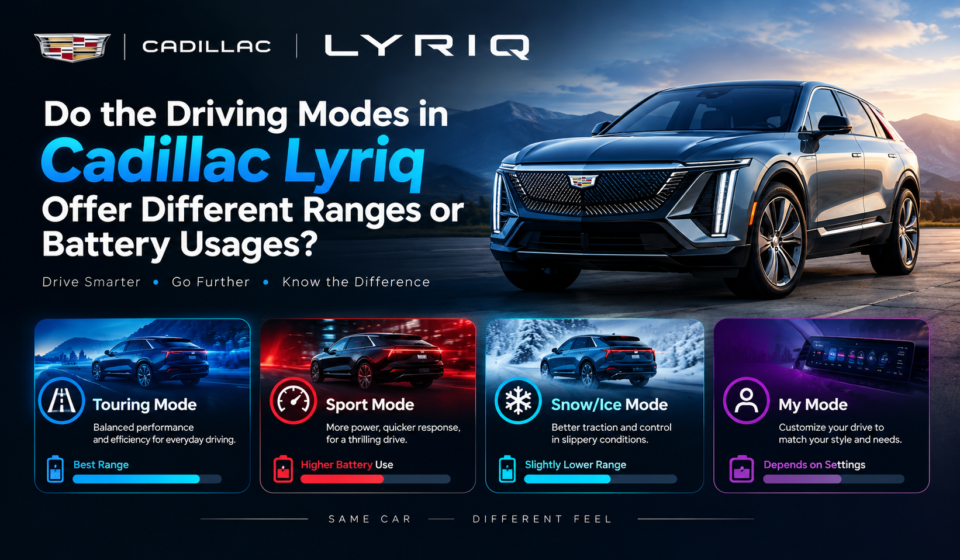
Do the Driving Modes in Cadillac Lyriq Offer Different Ranges or Battery Usages? Exploring Performance and Efficiency

The Cadillac Lyriq has quickly become an interesting choice for drivers looking for a premium electric SUV that combines modern technology, quiet performance, and luxury. Like many modern electric vehicles, the Lyriq gives drivers different ways to adjust the driving experience. These settings can influence how the vehicle responds to the accelerator, how it feels on the road, and how much energy is used in different situations.
One common question among potential and current owners is whether the Do the driving modes in cadillac lyriq offer different ranges or battery usages?. The short answer is that driving modes can affect energy consumption, but they do not normally create a completely separate battery range for each mode. Instead, the effect depends on driving style, road conditions, climate settings, speed, traffic, and how aggressively the vehicle is driven.
Understanding this relationship can help Lyriq owners choose the right mode for different situations while making better use of the vehicle’s available battery energy.
Understanding the Driving Modes in Cadillac Lyriq
Driving modes are designed to change certain characteristics of the vehicle rather than simply provide different battery capacities. The Lyriq uses electronic systems to manage acceleration response, steering feel, traction behavior, and other aspects of the driving experience.
The exact availability and behavior of individual modes can vary depending on the Lyriq configuration and model year. However, the main purpose remains similar: give the driver greater control over how the SUV feels while driving.
A mode focused on relaxed driving may make the accelerator response smoother, while a performance-oriented setting can make the vehicle feel more immediate and responsive. These differences can indirectly influence battery consumption because the driver’s behavior often changes with the selected mode.
For example, if a performance-oriented setting encourages stronger acceleration, the vehicle may consume more energy during those acceleration events. On the other hand, a smoother driving mode can encourage gradual acceleration and more consistent energy use.
Do Different Modes Create Different Driving Ranges?
Selecting a different driving mode does not mean the Lyriq suddenly receives a different-size battery. The usable energy stored in the battery remains fundamentally the same.
However, the estimated range displayed by an electric vehicle can change over time based on recent driving behavior and energy consumption. If a driver spends a lot of time accelerating quickly, traveling at high speeds, or using heavy climate control, the estimated remaining range may decrease faster.
This means that a particular driving mode can have an indirect effect on range.
Consider two Lyriq drivers starting with a similar battery level. One driver chooses a relaxed setting and drives smoothly through city streets. Another uses a more responsive setting and frequently accelerates hard. Even though both vehicles have essentially the same battery capacity, their energy consumption may be different.
The important point is that driving modes in Cadillac Lyriq influence the driving experience and can contribute to different energy-use patterns, but the mode itself should not be viewed as a separate range rating.
How Performance Settings Can Affect Battery Usage
Electric vehicles are particularly responsive to acceleration. The electric motor can deliver strong torque almost immediately, which is one reason the Lyriq can feel powerful and smooth.
That performance is useful, but frequent hard acceleration requires more electrical energy.
A sportier driving setting may encourage a driver to take advantage of the Lyriq’s instant electric response. Repeated acceleration from a stop, quick overtaking, and rapid increases in speed can increase power consumption.
This does not mean performance-oriented driving modes are inefficient all the time. Energy use depends heavily on what the driver does with the vehicle. A driver can select a more responsive mode and still drive smoothly. Likewise, even a comfortable mode can consume considerable energy if the driver frequently accelerates aggressively.
The driver’s right foot remains one of the biggest factors affecting real-world efficiency.
Why Smooth Driving Can Improve Efficiency
Smooth acceleration is generally beneficial for electric vehicle efficiency. Instead of repeatedly demanding large amounts of power from the motor, gradual acceleration allows the vehicle to build speed more consistently.
This is particularly useful in city traffic, where frequent stops and starts can have a major influence on energy consumption.
A relaxed driving mode may make it easier for some drivers to maintain this style because accelerator response can feel more controlled. Over a longer trip, those small differences in driving behavior can add up.
Smooth driving also helps reduce unnecessary speed changes. Maintaining a steady pace when road conditions allow can be more efficient than repeatedly accelerating and slowing down.
Regenerative Braking and Energy Recovery
Another important part of EV efficiency is regenerative braking. When the Lyriq slows down, its electric drive system can recover some of the vehicle’s kinetic energy and convert it back into electrical energy.
This process is different from simply using less energy. Regeneration helps recover a portion of energy that would otherwise be lost during deceleration.
The effectiveness of regeneration depends on several factors, including driving conditions, speed, braking behavior, battery state, and the vehicle’s control systems.
City driving can provide many opportunities for regenerative braking because traffic often requires repeated slowing. Highway driving at a steady speed generally provides fewer opportunities for energy recovery.
This is one reason why real-world EV range cannot be predicted from driving mode alone.
City Driving Versus Highway Driving
Road conditions can have a greater effect on battery consumption than the selected driving mode in many situations.
City driving involves frequent acceleration and braking. Although regeneration can recover some energy, repeated acceleration still requires electricity from the battery.
Highway driving presents a different challenge. At higher speeds, aerodynamic resistance becomes increasingly important. Maintaining a high speed can require substantial energy even when the vehicle is traveling steadily.
As a result, a Lyriq driver may see different efficiency depending on where the vehicle is driven.
A comfortable driving mode on a highway does not automatically guarantee maximum range, just as a more responsive mode in the city does not necessarily result in extremely poor efficiency. The entire driving environment matters.
Climate Control Can Have a Major Impact
Battery usage is not limited to moving the vehicle. The Lyriq also uses electrical energy for heating, cooling, ventilation, infotainment, lighting, and other systems.
Temperature can therefore play a significant role in real-world range.
During very hot weather, air conditioning can increase energy consumption. In cold weather, heating the cabin and managing battery temperature can also require additional energy.
This means two drivers using the same driving mode can achieve different ranges simply because they are driving in different weather conditions.
For drivers interested in maximizing range, managing cabin temperature sensibly and making use of available vehicle climate features can be just as important as selecting a particular driving mode.
Does Sportier Driving Always Mean Lower Range?
Not necessarily.
A performance-focused mode does not automatically drain the battery at a fixed rate. The effect depends on how the driver uses that mode.
If the driver selects a responsive mode but maintains a steady speed and avoids unnecessary acceleration, the difference may be relatively small. However, if the driver repeatedly uses the vehicle’s strong acceleration capability, energy consumption can rise considerably.
The same principle applies to almost every electric vehicle. The available performance can be used when needed, but frequent high-power driving will generally require more energy.
For everyday commuting, a smoother driving style is often more important than simply choosing a particular mode.
How the Battery Range Estimate Works
The range displayed on the Lyriq’s instrument panel should be viewed as an estimate rather than a guaranteed distance.
Electric vehicles continuously consider recent energy consumption and other operating conditions when estimating how far the remaining battery charge may take the vehicle.
If your recent driving has been efficient, the estimated range may appear more favorable. If you have recently driven at high speeds, accelerated aggressively, used significant climate control, or encountered difficult conditions, the estimate may fall.
This is normal EV behavior.
Therefore, a change in the displayed range after switching driving modes does not necessarily mean the mode has physically changed the amount of energy stored in the battery. It may reflect changing consumption patterns and updated calculations.
Which Driving Mode Is Best for Maximum Range?
There is no single mode that guarantees the highest possible range in every situation.
The best approach is to combine an appropriate driving mode with efficient driving habits. Gentle acceleration, moderate speeds, smooth braking, sensible climate control, and proper tire maintenance can all contribute to better energy efficiency.
Drivers who want a comfortable daily experience may prefer a relaxed setting. Those who want sharper responses may choose a more performance-oriented setting when appropriate.
For long journeys, however, overall driving behavior is usually more important than the name of the selected mode.
How to Get Better Range From a Cadillac Lyriq
Drivers looking to reduce unnecessary battery consumption can follow several simple habits.
Maintaining a reasonable speed is one of the most effective strategies. Higher speeds can require significantly more energy because aerodynamic resistance increases as speed rises.
Smooth acceleration is also valuable. There is no need to use maximum motor output every time the traffic light turns green.
Avoiding unnecessary rapid braking can help as well. Although regenerative braking can recover some energy, avoiding needless speed changes is generally more efficient than constantly accelerating and then slowing down.
Keeping tires properly inflated is another practical step. Incorrect tire pressure can increase rolling resistance and reduce efficiency.
Finally, using cabin heating and cooling thoughtfully can help preserve energy, particularly during extreme temperatures.
Why Driving Style Matters More Than the Mode Name
It is easy to assume that an EV’s driving mode determines its efficiency completely. In reality, the relationship is more complicated.
Two drivers can select exactly the same mode and achieve very different energy consumption figures. One may accelerate gently and maintain a steady speed, while the other may use frequent bursts of acceleration.
The vehicle’s weight, road surface, traffic, temperature, wind, elevation changes, tire pressure, and climate settings can all influence consumption.
That is why driving modes in Cadillac Lyriq should be considered one part of the efficiency equation rather than the only factor.
Balancing Performance and Efficiency
One of the advantages of the Lyriq is that it does not force drivers to choose between luxury and performance. Different settings allow the driver to tailor the vehicle’s personality to the situation.
A relaxed setting can be useful for everyday commuting and longer drives where comfort and smoothness are priorities. A more responsive setting can be enjoyable when stronger acceleration and a sharper driving feel are desired.
The key is understanding that performance and efficiency can coexist when used intelligently.
There is no problem with enjoying the Lyriq’s performance. The important consideration is knowing that repeated high-power acceleration will generally require more energy than gentle, consistent driving.
Final Thoughts
So, do the driving modes in Cadillac Lyriq offer different ranges or battery usages? They can influence energy consumption indirectly, but they do not give the vehicle a completely different battery capacity or a fixed range for each mode.
The biggest differences usually come from how the vehicle is driven. Acceleration, speed, traffic, temperature, terrain, climate control, tire pressure, and regenerative braking all contribute to real-world battery usage.
For drivers who want the best possible range, smooth acceleration and moderate speeds are more important than simply selecting a specific mode. For drivers who value stronger performance, a more responsive setting can provide an engaging experience while still allowing responsible energy management.
Ultimately, the Cadillac Lyriq gives drivers flexibility. Understanding how the vehicle responds to different settings allows owners to choose the right balance between comfort, performance, and efficiency without treating driving mode as the only factor controlling range.



[…] is where playing games on blog playbattlesquare becomes an interesting topic for modern players. A gaming-focused blog can provide more than simple […]