

Introduction
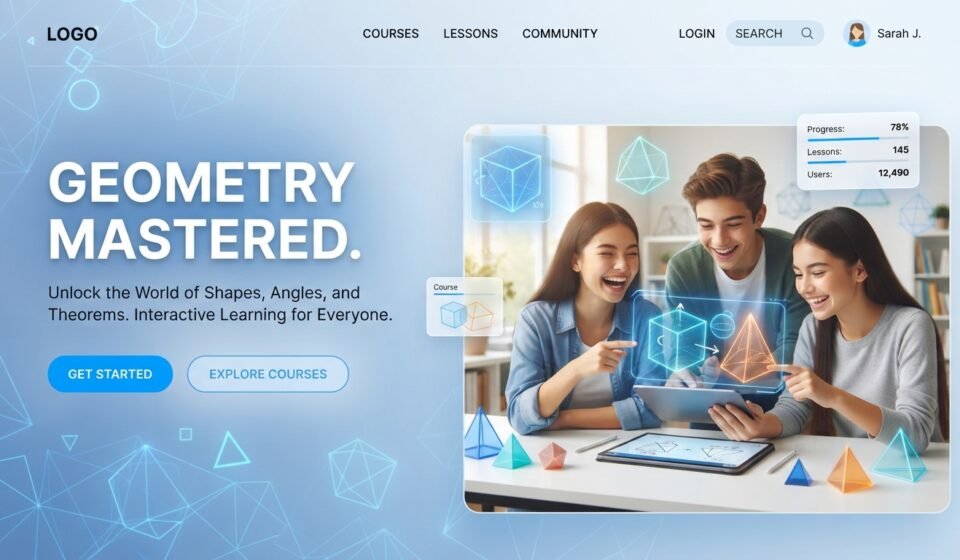
Geometry learning v3 is a search term associated with modern, browser-based and technology-supported approaches to learning geometry. Geometry itself focuses on shapes, lines, angles, measurements, spatial relationships, and mathematical reasoning, while digital geometry learning can make these concepts easier to visualize through interactive activities and simulations. Research on technology-supported geometry education has found that interactive and hands-on approaches can support visualization and spatial understanding.
At the same time, it is important to distinguish geometry learning v3 from a formally documented mathematics curriculum. Public information about the exact project is limited and inconsistent. Some online pages describe it as an educational platform, while other recent descriptions identify a browser-based project associated with the GL Series and sections such as Games, Apps, Extras, and Settings.
For students searching for geometry learning v3, the most useful approach is therefore to understand both the project name and the broader principles behind effective digital geometry learning. Interactive diagrams, visual explanations, practice problems, games, and real-world activities can all help learners develop a stronger understanding of geometry.
What Is Geometry Learning V3?
Geometry learning v3 is a term used online for a modern geometry-related digital learning experience, although its exact educational scope is not consistently documented. Some descriptions present it as an interactive resource where learners can explore mathematical concepts through digital activities, while publicly observable information about the GL Series project suggests a broader collection of browser-based content.
The idea behind geometry learning v3 fits a wider movement toward interactive mathematics education. Instead of learning geometry only from textbooks, students can use digital diagrams, animations, simulations, games, and manipulable objects to see how geometric relationships work. Research has found that technology integration in geometry education commonly includes tools such as dynamic geometry software, simulations, augmented reality, tablets, and interactive learning environments.
This approach can be particularly useful because geometry is highly visual. A student may understand the definition of a triangle but struggle to imagine how changing one angle affects the rest of the figure. Interactive geometry tools can allow the learner to manipulate the figure and observe the relationship directly.
Why Is Interactive Geometry Learning Important?
Geometry learning v3 reflects an important idea in mathematics education: students often understand geometric concepts better when they can see and manipulate them rather than simply memorize formulas. Geometry involves spatial relationships, so visualization plays an important role in understanding shapes, angles, dimensions, and three-dimensional objects. Research into hands-on spatial geometry systems has specifically linked interactive manipulation with visualization and conceptualization skills.
Interactive geometry learning can also make practice more engaging. Instead of solving dozens of identical problems on paper, students can work with diagrams, change measurements, test hypotheses, and receive immediate visual feedback. This can make geometry practice feel more active and help learners recognize patterns.
Another advantage of digital geometry learning is that students can connect mathematical ideas to real objects. For example, learners can measure the dimensions of a room, calculate the area of a surface, estimate distances, or identify geometric shapes in their surroundings. Research on geometry learning in real situations has explored activities involving real-world measurements, surface area, and distances.
Key Geometry Concepts Students Can Practice
Whether a learner uses geometry learning v3 or another digital geometry resource, several fundamental topics form the foundation of geometry education.
Points, Lines, and Angles
Points and lines are among the first concepts students encounter in geometry learning. Learners need to understand line segments, rays, parallel lines, perpendicular lines, and different types of angles.
Interactive diagrams can make these concepts easier to understand because students can observe how lines intersect and how angles change when a figure is manipulated.
Triangles
Triangles are another major part of geometry learning v3 and general mathematics education. Students commonly study equilateral, isosceles, scalene, right, acute, and obtuse triangles.
Learning about triangles also introduces important ideas such as the angle-sum property, the Pythagorean theorem, congruence, similarity, perimeter, and area.
Circles
Circle geometry includes concepts such as radius, diameter, circumference, area, arcs, chords, and central angles. Digital geometry tools can help learners visualize these concepts by allowing them to change the radius or diameter and observe how the circle changes.
Quadrilaterals and Polygons
Students also need to recognize squares, rectangles, parallelograms, rhombuses, trapezoids, and other polygons. Geometry practice involving these shapes helps students understand perimeter, area, symmetry, and relationships between sides and angles.
3D Geometry
Three-dimensional geometry introduces cubes, cuboids, cylinders, cones, spheres, pyramids, and prisms. This area can be difficult because students must mentally visualize objects that have length, width, and height.
Interactive 3D geometry tools can help by allowing learners to rotate objects and examine different faces, edges, and vertices. Technology-supported spatial geometry research has specifically explored interactive manipulation to improve visualization and spatial reasoning.
How Geometry Learning V3 Can Support Visual Learning
One of the strongest ideas associated with geometry learning v3 is visual exploration. Geometry is not only about formulas; it is also about understanding relationships between visual elements.
For example, a student learning about area can see a rectangle divided into smaller squares. A learner studying angles can manipulate two rays and observe the angle measurement. Someone studying volume can rotate a three-dimensional object and examine its dimensions.
Modern interactive geometry research also supports the broader value of technology-enhanced learning. A 2025 classroom study involving an augmented-reality geometry learning game reported improvements in students’ geometry understanding from pre-test to post-test.
Benefits of Using Digital Geometry Tools
Better Visualization
Geometry learning v3 and similar digital resources can make abstract concepts more visual. Instead of imagining a transformation or three-dimensional object, students can see it directly.
More Active Practice
Interactive geometry practice encourages learners to manipulate objects, solve problems, and test ideas. This creates a more active learning experience than simply reading definitions.
Support for Spatial Reasoning
Spatial reasoning is an important part of geometry learning. Students need to understand how objects relate to one another in space, especially when studying 3D geometry. Research on mobile augmented-reality geometry learning has focused specifically on facilitating spatial reasoning.
Real-World Connections
Geometry becomes more meaningful when students can connect mathematical concepts to everyday objects. Buildings, furniture, roads, screens, packaging, sports fields, and many other objects involve geometric measurements and shapes.
Flexible Learning
Digital online geometry learning resources can allow students to practice outside traditional classroom settings. Depending on the tool, learners may be able to revisit difficult concepts, repeat exercises, and learn at their own pace.
What Are the Limitations?
While geometry learning v3 may be useful as a digital resource, learners should not assume that every website using the name provides a complete or formally structured mathematics curriculum. Current public descriptions of the exact project differ, and some sources caution that its educational purpose and full feature set are not consistently documented.
A digital tool also should not completely replace instruction, textbooks, worked examples, or teacher guidance. Effective geometry learning generally requires a combination of conceptual explanation, practice, feedback, and reasoning.
Students should also avoid relying entirely on games. Geometry games can make practice enjoyable, but understanding why a formula works is more important than simply obtaining the correct answer.
How to Use Geometry Learning V3 Effectively
If you are exploring geometry learning v3, use it as part of a broader study routine rather than depending on one resource.
Start with the basic concept. For example, before practicing triangle-area problems, make sure you understand what base and height mean.
Next, use a visual or interactive activity to reinforce the concept. Seeing a geometric relationship can make an abstract definition easier to remember.
After that, solve traditional geometry practice questions without assistance. This step is important because students need to demonstrate that they can apply the concept independently.
Finally, review mistakes. If you repeatedly make errors with angles, area, or volume, return to the visual explanation and identify exactly where the misunderstanding occurs.
Search Questions About Geometry Learning V3
What is geometry learning v3?
Geometry learning v3 is an online search term associated with a browser-based project and broader discussions of interactive geometry learning. Public descriptions of the exact project vary, so users should verify the specific website and its available content before treating it as a formal mathematics course.
Is geometry learning v3 useful for students?
Digital geometry learning resources can be useful when they provide clear explanations, visual interaction, meaningful practice, and feedback. Research on interactive and technology-supported geometry education suggests that these approaches can support visualization and conceptual understanding.
Can geometry learning v3 help with 3D geometry?
Interactive 3D geometry tools can be particularly helpful for spatial concepts because students can manipulate and visualize three-dimensional objects. Hands-on and technology-supported spatial geometry approaches have been studied for their effects on visualization and spatial reasoning.
Is geometry learning v3 suitable for beginners?
Beginners can benefit from geometry learning resources when they start with fundamental topics such as points, lines, angles, triangles, and basic measurements. However, the suitability of the specific Geometry Learning V3 project depends on the actual content and activities available on the version being accessed.
Can geometry games improve geometry skills?
Geometry games can provide additional practice and engagement, but games work best when they reinforce mathematical concepts rather than replace systematic instruction. Recent research into interactive geometry simulations has reported learning gains alongside increased engagement-related measures, although results depend on how the learning activity is designed.
FAQS
What topics should I learn first in geometry?
Start with points, lines, angles, basic shapes, perimeter, and area. Once these concepts are comfortable, move to triangles, circles, polygons, transformations, similarity, congruence, and 3D geometry.
Why is geometry difficult for some students?
Geometry can be challenging because it combines visual reasoning, mathematical vocabulary, formulas, and logical relationships. Geometry learning becomes easier when students use diagrams and connect formulas with the shapes they describe.
Are interactive geometry tools better than textbooks?
They serve different purposes. Interactive geometry learning tools are useful for visualization and exploration, while textbooks are valuable for structured explanations, examples, definitions, and exercises. Combining both can provide a more complete learning experience.
How can I improve my geometry skills?
Practice consistently, draw diagrams, learn the meaning behind formulas, solve different types of problems, and review mistakes. Using interactive geometry practice can add visual reinforcement to traditional problem-solving.
Why is spatial reasoning important?
Spatial reasoning helps learners understand how shapes and objects relate to one another. It is especially important for 3D geometry, measurement, transformations, architecture, engineering, design, and many technical fields.
Conclusion
Geometry learning v3 represents a broader interest in making geometry more interactive, visual, and accessible through digital technology. However, because publicly available information about the exact project is inconsistent, it is best to evaluate the specific resource based on its actual content rather than assuming that the name represents a complete educational curriculum.
For effective geometry learning, the most important goal is understanding rather than memorization. Interactive diagrams, geometry games, 3D visualization, real-world measurement activities, and traditional problem-solving can work together to build stronger mathematical skills. Research continues to show potential benefits from technology-enhanced geometry education, particularly when digital activities are thoughtfully connected to genuine learning objectives.